Author: grapier

I'm an emerging fiction writer trying to build awareness and open up opportunities on the web,

End of the Road?

Just wondering If anybody is out there. . . .
I haven’t blogged for a while now and am wondering if I should keep doing it. I know this sounds whiny, but I truly doubt if further effort is really worth the trouble. Let me explain.

Why I started it: I created this website in 2012. Back then I’d finished a new novel and was trying to get representation for it by sending out query letters and searching the web for advice. In several places I read that even new, unpublished authors should set up a website. I suppose the reason is that agents or publishers might want to learn more about you. So I did that. It wasn’t a blog, just basic facts about myself and my writing. The site had a kind of homey feel to it—not professional at all.

Then: I kept on writing, and for the next five or six years I wrote a lot. Actually, I started more stories and novels than I finished. But I did complete four novels. Two were supernatural in genre; one was a straight mystery; the last was The Truth About Jacob Marley, which is hard to classify. No agents were very interested in any of these, though a few asked to see the complete manuscript.

Relocation: Then I moved to another state to be closer to family (I’m retired, by the way). That caused a hiatus in writing. But then something happened. A small press was interested in publishing the Marley book. The arrangement required some investing on my part, but I knew someone connected with the publisher, so I was sure it was on the up and up. In 2020 I worked with an editor and a book designer to bring the book out. It was published late in that year.

Website: After publication I revised the website extensively. Later, I hired a media expert to help me, and he suggested adding an active blog to the site. So that’s what I’ve been doing, in the hopes of stirring up interest in the book.

The awful truth: The book is not doing well, even after receiving a glowing Kirkus review earlier in the year. But I am happy, however, with the look and feel of the improved website. The idea was to stir up interest on the Internet, but the result is not gratifying. Why? One: book sales are dismal. Two: I’m not at all certain anyone reads or is interested in what I’ve added in this blog portion of the website. I’ve wracked my brain trying to write interesting pages that are related to good old Jacob Marley.

What really bothers me about the blogging is that I’ve gotten almost no feedback. I did hear from two different author/bloggers who showed me their websites. Nothing from ordinary readers or even slightly curious web surfers.

I’ve listed a place for comments. I’ve also encouraged comments via email, Facebook, or Twitter. But I’ve gotten no feedback from those. At this point I’m more interested in getting feedback about the blog than I am the book! At least then there would be some connection with other people. Maybe I’d learn something. The book will still be around and it’s always possible that it will strike a chord and “be discovered.”

So here I am, possibly writing my last blog. If I don’t get some kind of feedback by Christmas, I’ll stop blogging. Perhaps I was wrong to think my musings would interest anyone. If you do respond, please send ideas or tell me where I went wrong. In the new year I plan to resume writing a novel I’ve put off for six months.

Anyway, here’s hoping you have a good holiday.

Parallel Lit.

Exactly what is a parallel novel?

I mentioned on the About Me page that The Truth About Jacob Marley is a “parallel novel.” I thought I knew what the term meant, but the Wikipedia article on the subject discusses several other meanings it might cover. The main point, though, is that the new work is written by a different author than the original, which is usually a well-known novel, often a classic. It can be set in the same period, might use some of the same characters, or might add characters. It can be a prequel or a sequel, or take place in a totally different time period. A minor character in the original story might become the main character in the new one. There are many ways to do it.

One thing the article mentions is that the term is a “pastiche,” meaning it is not a parody, but rather something that celebrates the original work’s atmosphere and ethos. But as we will see, this is not always the case.

The first parallel work I ever encountered wasn’t a novel, but a play, Tom Stoppard’s Rosencrantz and Guildenstern Are Dead. The play is parallel to Shakespeare’s Hamlet. In Hamlet the two title characters don’t have many lines and are mere pawns. At the end of the play they, like almost everyone else, are dead. I loved that Stoppard would show the tail-end of a scene from Hamlet and then leave these two misfit characters on stage, bewildered and ignorant of what is going on. They’re not bright. Their lines are in present-day speech and generally talk about trivial things. In this play, then, the setting is not really important, and nothing about the original play is changed. Rosencrantz is absurdist in tone. You might compare it to Waiting for Godot.

The Wind Done Gone, a novel by Alice Randall, is different. It uses some characters from Gone with the Wind and adds new ones. Most of the names are changed or avoided or abbreviated; the reader recognizes them, however. Notably it follows the story of a slave girl who is the half-sister of Scarlett O’Hara. Here is a biting satire that does not celebrate the mythical era of the Old South, but instead gives us a jolt of realism concerning the period and strips any romantic notions we might have had about it.

Wicked by Gregory Maguire is a novel that also does not celebrate much about its progenitor, The Wonderful Wizard of Oz. Rather, it completely changes the landscape and the characters to a high degree. It takes a classic children’s book series and changes many, many things, adding sexual situations and other adult memes. It’s not intended for children, of course. The writer seemed determined to create his own complex fantasy world; not sure why he picked Oz as a starting point. I personally did not care for the result. To each his own. Perhaps I am too fond of the source material.

Mary Reilly by Valerie Martin is a well-written novel based on Dr. Jekyll and Mr. Hyde. It’s the same basic story seen through the eyes of a chambermaid in the house of Dr. Jekyll, with whom she is in love. This is perhaps the purest parallel novel I’ve read.

The pattern I see is that these re-imaginings are all based on well-known classics, such as the ones mentioned above and others, like Pride and Prejudice, Beowulf, Little Women, and Jane Eyre. The list goes on.

As for my own “paralleling” of A Christmas Carol, I think the result is more on the celebratory side of things. I put most of my narrative within the time framework of the original. But I also explained a few things that occurred before and after Dickens’ narrative, so I lengthened the full story. And of course we know from page one that Marley was not a ghost on the night Ebenezer Scrooge had a change of heart. That fact influences much of what follows. I really enjoyed learning about this period of history, so yes, I was celebrating it.

I portray Scrooge more realistically than does Dickens. Don’t worry, Scrooge is still a man in need of reform, but in my story he’s not quite as fiendish as Dickens portrays him. And he’s more interesting in other ways—for instance, he is a voracious reader and has an affinity for things American.

Two other characters, Jacob Marley and Fred, Scrooge’s nephew, are fleshed out into more rounded characters.

Fred is the narrator of the book and the conscience of the story. In Dickens, Fred has a famous speech he delivers to his uncle about Christmas (“. . . I believe it has done me good and will do me good; and I say “God bless it!”), but other than that he has little else to do until Scrooge at last comes to his house as a changed man. In my version Fred spends a lot of time trying to get to know and understand his uncle, who is his only living relative. And he is partly the reason Scrooge at last mends his ways.

As for Marley, he was perhaps beyond redemption. And yet he is interesting, as shady characters often are. As Fred states late in the book, Marley was the spark that caused most of the major events, turning points, and reversals of the narrative. In fact, you could say that Marley is the pivotal character.

I won’t comment on ghosts or the lack thereof.

Zounds!

Some thoughts about an American writing a novel set in Britain.

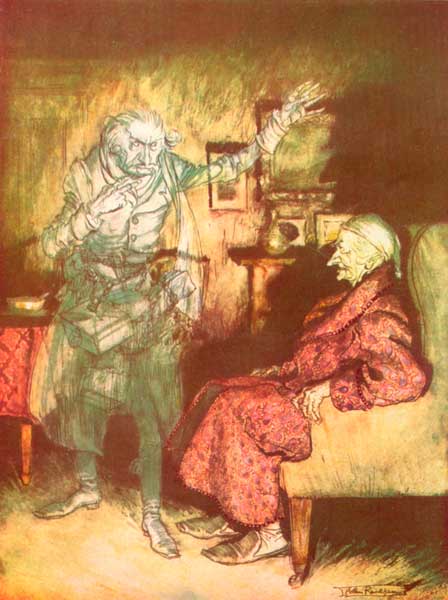
Illustration by Arthur Rackham

Sometimes I’m amazed that I wrote a quasi-British novel, something I’d never before aspired to do, either as a humorous or serious effort. I’m even more amazed that it got published. How could I dare do something like that? The answer is that in the beginning I treated The Truth About Jacob Marley as a lark, a mere exercise in story-telling. My idea for an alternative version of A Christmas Carol delighted me so much that I kept at it. In the end, I thought there might be something worth sharing.

There was another reason I thought I could handle the task, or at least “give it a go.” After I got started, I felt right at home in the fictional world I was creating. I’m not sure I can call myself an Anglophile, but I’ve read a lot of English writers over the years and think I have a feel for the rhythm of that prose. It sounds bold to say that, but I was feeling pretty confident. And I told myself that if the novel every got tapped for publication, maybe I’d get a British editor to correct any stray errors. Such an editor never appeared, though.

From a prior experience, I knew mistakes could easily happen.

Some years ago I co-wrote a play called Agatha Christie Takes Manhattan. The idea came from Eddie Cope, a fellow playwright and a friend. We were both living in Houston at the time, and he asked me to work on the project with him. This was to be a comedy-mystery featuring Agatha Christie as the main character. She is asked to come to New York to direct a mystery play not of her own making. During rehearsals for the play-within-the-play, there is a murder and guess what? Agatha solves it. Most of the characters were American and eccentric, if not loony. There are a lot of laughs in it. The play was produced in Thousand Oaks, California and later in Houston.

Before any of that, we had a reading of the play before a small audience in Houston to get a reaction and criticism. We asked an actress we knew well, Melrose Fougere, who happens to be English, to read the role of Agatha Christie. During rehearsal for the reading, Melrose found a couple of glaring errors, including a reference to a woman’s “purse,” which I wrote in a line of dialogue. “Oh, no, she would never say that!” she advised us. “It should be ‘handbag.’ A purse is something completely different.”

How was I to know that? There is no way, actually. That’s a word that really sneaks up on you. So I was aware those kind of slips could occur in the Marley novel. Still, I thought because it was set in the early Nineteenth Century I might be safer. I mean, if I knew a word had been used by Dickens, say, I could count on it. If a word sounded questionable to me, I looked it up to see when it entered the language. And some dictionaries have a “British” addendum giving their version of a definition. All of that helped me sleep at night.

So I was careful about word choice during the self-edit phase. But I also felt a need to avoid too many British-isms, especially ones that might turn off readers. So you won’t find “zounds” or “blimey” in the book.

I constantly censored myself myself when I edited, sometimes changing word choices that seemed too British or highfalutin. If I thought a word sounded too exotic to the American ear, I’d substitute another word for it. There was usually a variant or close synonym I could use, one that we would recognize and which was perfectly valid for the speaker to use. As an example, I might have first written “despondent” about someone’s mood. (You’ll find that word in Dickens, actually.) But thinking it was too literary, I might have later substituted “dejected” for it. They mean the same, after all. I know that sounds like I’m “dumbing it down” but not really. They’re both fine English words. I was doing this to make the prose easier to read, even it there was nothing wrong with the first word. I wasn’t trying to emulate Dickens, you see, or impress the reader with my scholarship. On the contrary. The narrator of the story, Fred Truelock, had his own way of talking and writing.

Despite that, one reader told me she had to look up a lot of things anyway. Well, I’m glad she kept reading, for she told me she enjoyed the book.

So I tried hard to make the prose authentic and accessible. Still, if any reader stumbles across this blog and you have found something horrendous in the book, like the use of “purse,” please email me!

Who Owns America?

Or at least the name….

Map of America, Jonghe, 1770

On the About Me page on this site I mentioned that I brought portions of the Marley novel to my writing group every week as it was being written. The other day I happened to glance at something in the finished book that reminded me of an issue someone brought up one night.

In a scene I read for the group, a character refers to the United States simply as “America.” The writer who brought this up is a friend of mine, and her question was worth discussing. Julie had a friend from South America who hated hearing “America” used to mean the United States of America. The friend thought that using “America” in that way was conceited and pretentious.

I’d never considered this a serious problem, though I’ve always been aware the usage is incorrect. North and South America comprise lot of real estate. They take up most of an entire hemisphere. Now that I think about it, I can’t imagine a citizen of Argentina, for instance, saying about someone, “He’s not here, he’s on vacation in America.” No way.

Remember where the name come from? Amerigo Vespucci, one of the earliest European explorers of the new world, was the first person to claim that the lands Christopher Columbus had discovered were new continents and not part of Asia, as Columbus maintained. Eventually this was accepted by the Europeans. A German mapmaker later wrote a book on geography and in it suggested that the new lands be named for Amerigo. Apparently names of continents have to be feminine, and America is the feminine form of Amerigo. So there you have it. Two huge continents named for one guy.

Back to the critique. My answer to this objection was that the incorrect usage was appropriate for the British character who spoke the words. I was well aware that Brits have been in the habit of referring to the United States as “America” for as long as we’ve been a country, and even before that. Luckily, I was backed up by others in the room. I mean, if you’ve read a lot of English novels you can’t escape knowing that factoid. Alistair Cooke, a famous English journalist, had a regular column called “Letter from America.” Call it a colloquialism. Of course, everybody knows that’s it’s not the official name. If an Englishman needs to refer to our president, he doesn’t say “the President of America.” At least, I hope not. Horrors!

Part of the problem is our country’s official given name. You would have thought the founding fathers would have had more creativity. “United States of America” is such a mouthful that it’s no wonder English-speakers on both sides of the Atlantic have looked for something shorter.

We’re not the only country with this problem. Consider our former mother country. What do we call it? England? Britain? Great Britain? England, Scotland, Wales, and Northern Ireland? The United Kingdom? The UK? Brexit? Take your pick.

I think an even more flagrant mistake is in using the adjective “American” to mean “of the USA.” I consider myself an “American,” true enough. That usage is pretty well set. But we also have phrases like “the American Dream,” companies like “American Airlines,” policies that might be “un-American,” and philosophies like “the American way of life.” With so many things already staked out, it’s hard to see how we could ever reverse it. No, it’s too late. As I said, it’s colloquial usage and the world has mostly adjusted to this peculiarity.

Sorry, Latin America and Canada, I doubt this will ever change. Hopefully scientific and technical works don’t use “America” as loosely as we do in speech and everyday prose.

On Historical Fiction

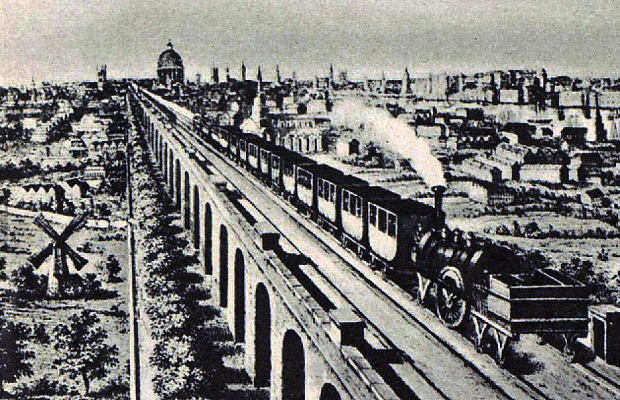
According to Scrooge, it was the Age of Steam!

The London & Greenwich Railway, 1837

I began writing The Truth About Jacob Marley without much planning. But I did know a few things. For instance, I needed Jacob Marley to be alive on the Christmas Eve of 1841, exactly as Frederick Truelock states on Page 1 of the novel. I picked 1841 because Dickens’ novel came out in December of 1842. I started keeping a spreadsheet before I wrote much else and I’m glad I did. In it I listed the years, how old characters were at the time, and when the plot points occurred. My novel begins much earlier than does A Christmas Carol, but of course I drew some of the earlier parts from Stave Two, when Scrooge is visited by the Ghost of Christmas Past.

I also put a couple of markers in the spreadsheet: “Victoria becomes queen” and “V marries Albert.” Those were the only historical events I thought of initially. I hadn’t realized yet that I was writing a historical novel—if you can call it that. A Christmas Carol is certainly not one. Dickens was writing about his contemporary society at the time, and any mention of poverty or unfair laws is also contemporary. He never refers to current events in this book, as far I can tell. Most historical fiction is about major events (e.g., War and Peace) and how people were affected by them. Dickens would later do that with A Tale of Two Cities. But not here.

So I started out only worrying about what kind of guy Marley was. But I wanted my novel to be accurate of course, so I kept looking things up online. I had questions. When were those cloth machines in Manchester fully up and running? When did the railways start? When did people start taking laudanum or other drugs? Every time I felt a character might be about to do something questionable for the time period, I looked it up. After a while, I began to see that the details I put in the story were giving it a flavor and richness that I liked. I thought of it as background scenery.

Looking back on the whole process, I think a case could be made for my novel being called historical fiction after all. Why? Because my characters are sometimes influenced by certain events, or at least by certain changes in society, that were afoot. For instance, and this turned out to be a lucky discovery, the whole idea of the Christmas tree was fairly new. Sure, people were decorating by placing greenery and mistletoe in their homes, but a whole tree? The landed gentry might be doing that, but not many everyday people. I stumbled on something else. On their first Christmas together, Prince Albert surprised the Queen by secretly importing spruce trees all the way from his native home in Germany to the palace. It was in all the magazines, you know. So ordinary people started chopping down evergreen trees or buying them from street vendors.

There were other lucky discoveries. When Fred’s wife goes home to visit her mother, I wondered if she might go by rail. It turns out the world’s first elevated railway was built between between a point near London Bridge to Greenwich. They built brick viaducts (see picture at top) containing more than 850 arches to elevate the rails. And Fred is very concerned about the safety of this engineering wonder. Who can blame him? So here is a small moment in history that served to influence my plot after I discovered it. That wasn’t all. When Fred decides to mail a letter to his wife, my radar went off again. How did one mail a letter in those days? It turns out that adhesive stamps were now available. They were not perforated, so you had to cut them out of a sheet. The stamp only cost a penny and with it a half-ounce letter could be sent to any place in the country. That fact had little bearing on the story, except to save Fred a trip to the post office, but it does add more color.

For me, this kind of historical fiction flows from the needs of character and plot to the historical events, not the other way round. I didn’t read about the railway and decide to put it in my story; I had a need for a railway and found one that was interesting.

But things still flow both ways, for by choosing that preposterous elevated railway, I gave Fred one more thing to worry about.

I once wrote to a friend suggesting this blurb: “In this engaging novel the events of the classic Christmas story are re-imagined and set against the panorama of the early Victorian era.” I still think that is a good description for it. “Panorama” contains the historical backdrop that I wanted and needed but had to discover as I went along.

Marley: Two Profiles

Jacob Marley — one of the best-known ghosts in literature.

This is the illustrator Arthur Rackham’s version of the ghost of Jacob Marley visiting Scrooge.

My conception of Jacob Marley is quite different from the character Charles Dickens created. My Marley had to be different, since the whole story is based on flipping the first six words of the book. Dickens starts with the famous line, Marley was dead, to begin with. My novel begins with Marley was alive, to begin with, and we learn that we’re reading a memoir written by Scrooge’s nephew, Fred, who late in life wants “to set the record straight about the events of Christmas, 1841.”

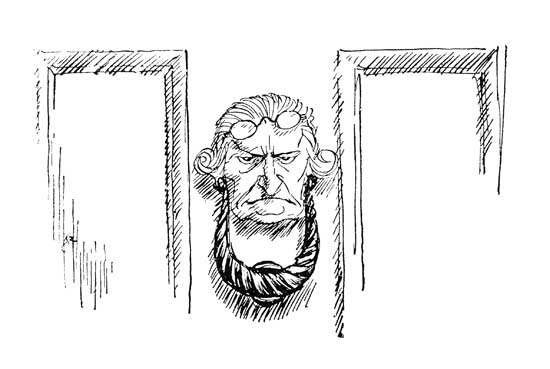
Dickens tells us very little about Marley, the longtime business partner of Scrooge. After emphasizing that he was “dead as a door-nail,” Dickens has Scrooge tell the two portly gentlemen that Mr. Marley “died seven years ago, this very night.” Going home that evening, Scrooge sees Marley’s face in the door-knocker. Later Marley appears as a ghost, and confesses that he forged the chains he wears by not caring for anything except business. Marley has been tasked to let Scrooge know what will happen to him if he doesn’t change his ways. That’s all we know about this Marley.

Fred begins memoir by recounting early childhood memories of meeting Mr. Marley. His uncle Scrooge brought his partner in tow on certain occasions, usually holidays, when he would visit his sister, who was Fred’s mother. Later, when Fred has grown up, Scrooge tells him the truth about Jacob Marley and his roguishness. Some of it is not pretty. Both men loved money. But whereas Ebenezer Scrooge was miserly in his ways, Marley was a spendthrift and hell-raiser who took one chance too many.

So there you have two profiles. Marley is more prominent in my tale, I think, though he’s not the only character to watch. Even though I’ve added a lot to Dickens’s original idea, I have kept Marley’s pigtail intact!

Amodio Misses an Easy One

(Show airing on Oct. 7, 2021)

Matt Amodio, the reigning wunderkind of Jeopardy!, is certainly a phenomenon, with over $1 million in winnings so far. And he’s still going! I expect him to pass James Holzhauer before long.

But he missed an easy one last night, something that truly puzzled me. You’ll soon see why the clue struck me personally as “easy” in a moment.

It was near the end of the Jeopardy round. The category was “Character Development” and it was the $200 clue. The harder answers had already been dealt with (Amodio usually goes from the bottom up). This category was about coming up with the name of a fictional character. The clue:

In an 1843 story, paranormal activity around the holidays convinces this business owner to stop making his employee’s life hell.

Matt rang in and said in his characteristic manner, “What’s Marley?” That was not correct, of course. Another contestant, Maddie, rang in with the correct answer: “Who is Scrooge?”

Maybe it was the way the clue was worded. After all, Jacob Marley (who was part of the “paranormal activity”) had already been convinced himself before the story opened. Ah, well. In my reimagining of the story, The Truth About Jacob Marley, there is far less paranormal activity to deal with. But in the end Scrooge still manages to become convinced of his failings and gives his employee, Bob Cratchit, a raise. (Available on Amazon and Barnes and Noble websites.)

My First Post

I’m a writer now living in north Texas. My Welcome page tells you everything you need to know about my first published novel. This has happened a bit late in my life, to be sure, as I’m now in my seventies. 🙂 I mention that in the the spirit of full disclosure. Hopefully, more novels will follow, though. If you’ve read the book, please let me know what you thought of it. (And no, the below photo is not of Texas.)

TPhoto by S Migaj on Pexels.com